COMMITTEE FINDS WAY BACK TO EUROPE
Scientists question the plan. Archivists demand to see the original paperwork.
A government committee has announced that it has discovered a way to bring Britain closer to Europe, although scientists have warned that the proposal may encounter difficulties involving several hundred thousand years of geological history.
The Committee for Landmass Optimisation and Strategic European Realignment, known as C.L.O.S.E.R., was established following calls for Britain to develop closer relations with its European neighbours.
The project reportedly began when junior policy officer Hunter Dart read a Downing Street description of a “drive to get closer to Europe” and began costing the route.
His preliminary report recommended that the government investigate moving Britain itself.
Committee chairman Sir Basil Starr-Taft welcomed the proposal, describing it as a practical response to a longstanding geographical problem.
“We've spent years discussing how Britain can get closer to Europe,” Sir Basil said. “It seemed sensible to establish whether anyone had tried moving it.”
The committee's confidence increased after researchers identified evidence that Britain and continental Europe were once connected by a chalk ridge across what is now the Dover Strait.
Scientists believe enormous flows of water helped destroy the connection hundreds of thousands of years ago, creating the separation visible today.
Imperial College London scientists, announcing findings in 2017, described the prehistoric event as “Brexit 1.0”, terminology which the committee has enthusiastically adopted.
“If there was a Brexit 1.0,” Sir Basil said, “it follows that there must have been a time before it. We are simply investigating the possibility of returning to the previous arrangement.”
The committee's technical annex goes further.
It notes that Britain and France sit on the same tectonic plate, which it describes as “clear evidence that France is already on board”.
It also cites research showing that southern England has been gradually sinking since the last ice age, concluding that the country is “already sliding gently in the right direction”.
Scientists contacted by The Weekly Wally said that none of these findings meant what the committee thought they meant.
A committee spokesperson described the scientists' findings as “an extremely encouraging starting point”.
Asked whether the scientists supported the proposed method of reconnection, the spokesperson said the matter would be considered during the next phase.
However, the committee has encountered an unexpected obstacle from government archivists.
The archivists have formally objected to any work affecting the White Cliffs of Dover until a search for the original construction plans has been completed.
They believe important historical documentation may remain buried somewhere within the chalk.
When asked whether there was any evidence that the prehistoric land bridge had been constructed according to written plans, an archivist replied that no such evidence had yet been found.
“That,” he said, “is precisely why an investigation is necessary.”
The investigation has since widened following suggestions that the missing documents may concern something considerably more ambitious than the original Channel crossing.
According to one archivist, the material could include preliminary designs for an improved version of Earth.
“We understand that certain aspects of the original design may have been reconsidered,” he added. “We are particularly interested in establishing whether politicians were included in the initial specification.”
No evidence has been produced that these documents exist.
Nevertheless, the committee has accepted the archivists' request.
All physical work on the proposed geographical realignment has been suspended until the original plans can be located and examined.
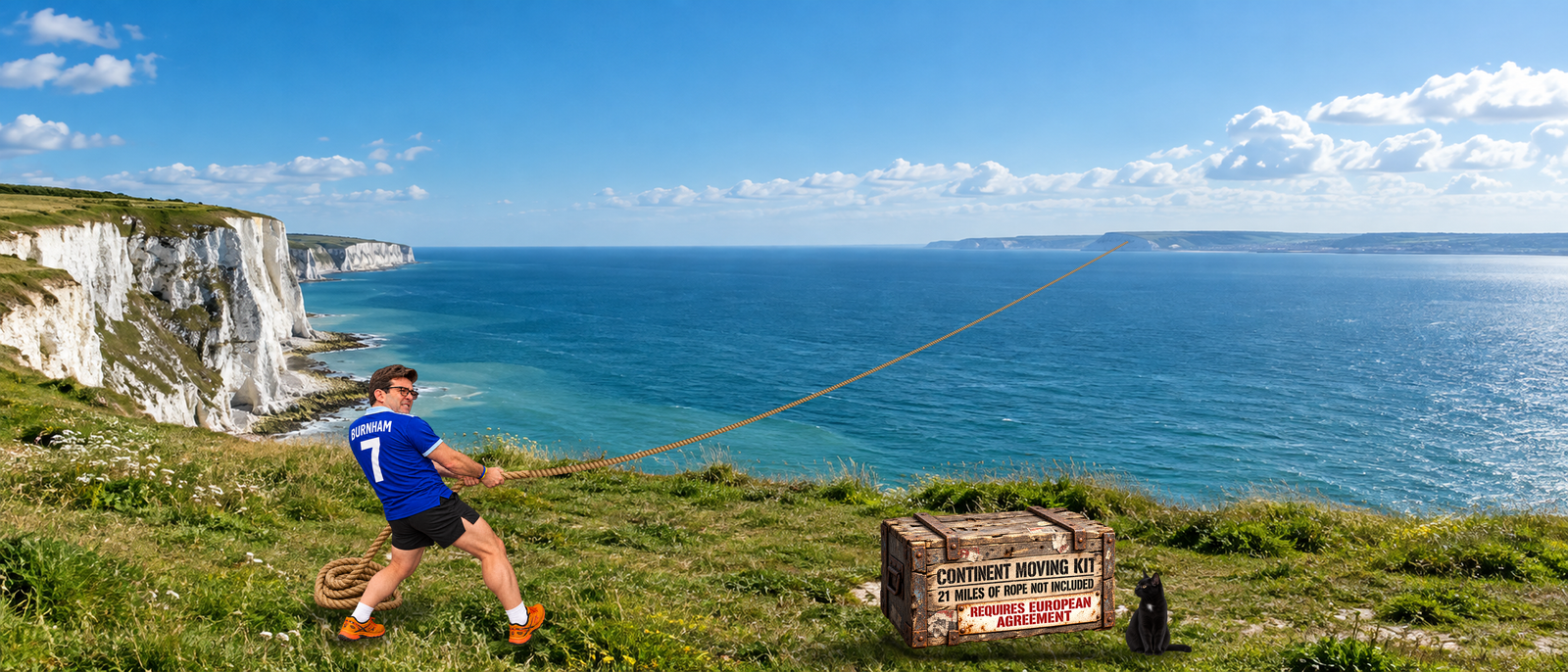
This includes early trials on the clifftop at Dover using a length of rope. A crate of equipment remains on site.
Scientists have welcomed the suspension, while reiterating that the scheme was never physically achievable.
Sir Basil Starr-Taft described the outcome as an important milestone.
“We have completed the first phase, identified the principal obstacles and established the need for further investigation,” he said.
Asked when work might resume, he replied:
“That depends on how long it takes to find the paperwork.”
The committee has declared the first phase a success.